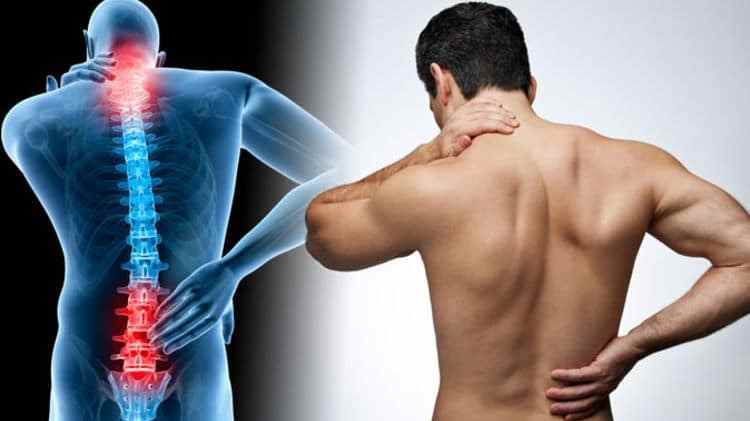

[A physiotherapist can use prefix as dr | physiotherapist can be called as doctor | physiotherapist can use dr or not | physiotherapist are doctors supreme court ]
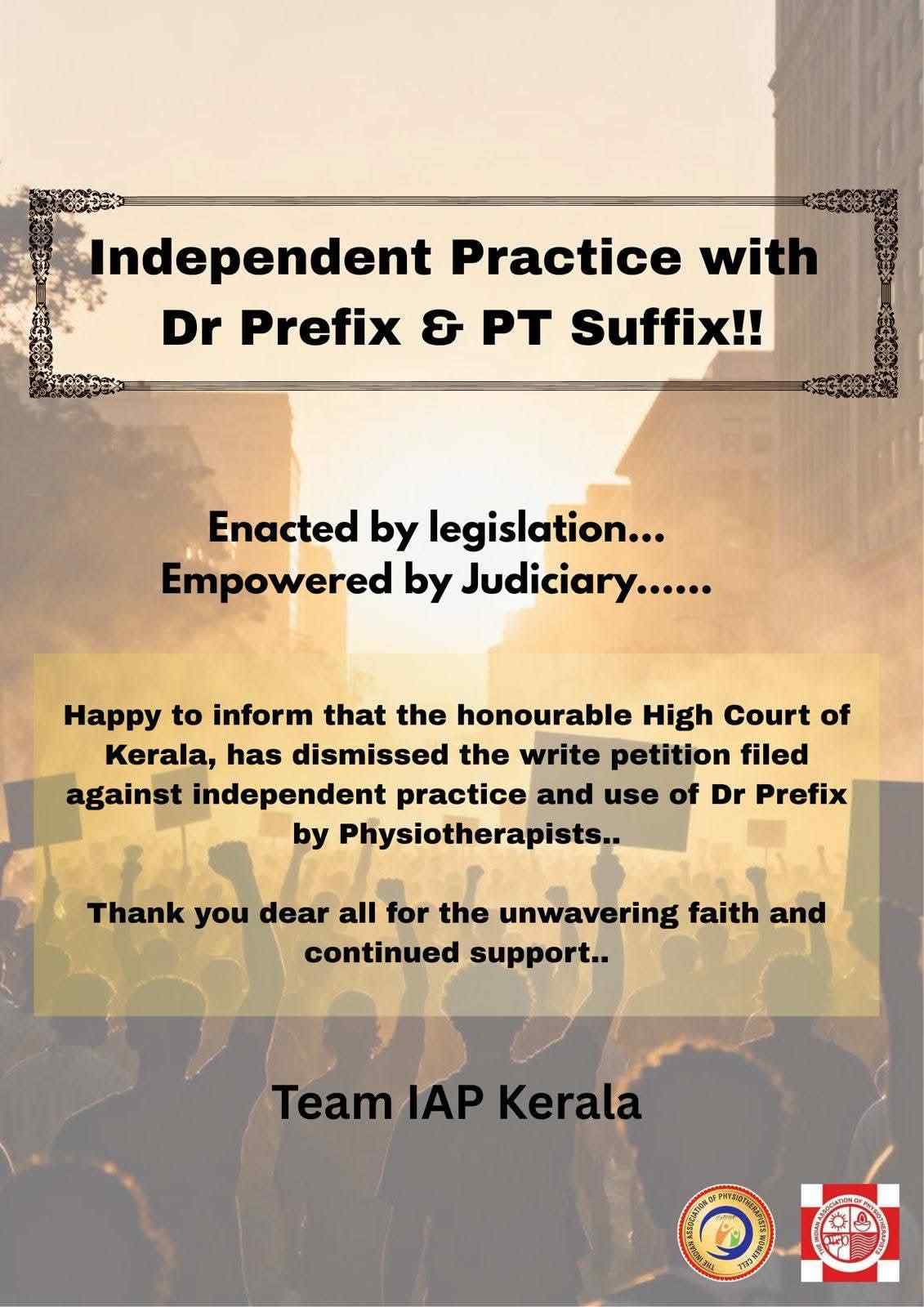
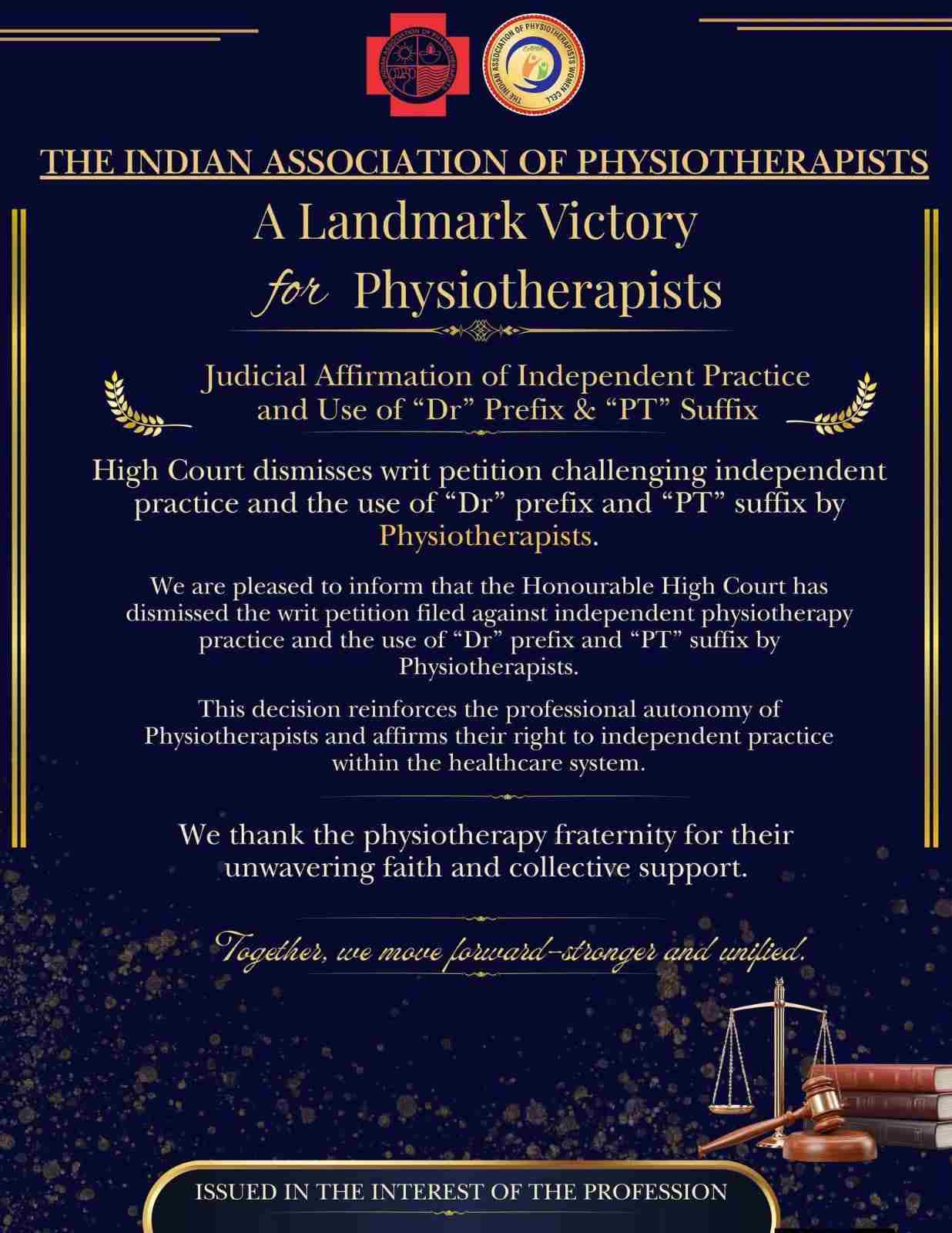
The long-pending case between IMA, IAPMR, and physiotherapists in the Kerala High Court has finally come to a close. After years of discussion and legal scrutiny, the court has delivered a clear and positive decision.
The Kerala High Court has acknowledged physiotherapy as an independent and recognised healthcare profession. The court has stated that qualified physiotherapists are permitted to use the “Dr.” prefix, provided it is clearly followed by the suffix “PT”.
This decision ensures clarity for patients. “Dr. (Name), PT” transparently identifies the professional as a Doctor of Physiotherapy, not a medical doctor. There is no intention to mislead, and the suffix “PT” clearly defines the scope of practice.
The court also recognised the extensive academic and clinical training physiotherapists undergo.
With structured education, clinical responsibility, and ethical accountability, physiotherapists play a vital role in modern healthcare—especially in rehabilitation, pain management, and functional recovery.
This judgment supports professional dignity, patient awareness, and multidisciplinary harmony in healthcare. It reinforces that different healthcare professionals can coexist with mutual respect, each contributing their expertise for the benefit of patients.
The closure of this case marks a positive milestone for physiotherapy in India. It strengthens professional identity while keeping patient safety and transparency at the center.

Who Is a Physiotherapist?
A physiotherapist is a first-contact healthcare professional trained to assess, diagnose, and manage conditions related to:
- Musculoskeletal pain and injuries
- Neurological disorders (stroke, Parkinson’s disease, spinal cord injury)
- Cardiorespiratory conditions
- Sports injuries
- Post-operative rehabilitation
- Geriatric and pediatric movement disorders
In India, physiotherapists undergo intensive academic and clinical training, including:
- BPT (Bachelor of Physiotherapy) – 4½ years including internship
- MPT (Master of Physiotherapy) – advanced specialization (Orthopaedics, Neurology, Sports, Cardio-Pulmonary, etc.)
- Doctoral qualifications (PhD) in many cases
This education includes clinical diagnosis, differential screening, evidence-based treatment planning, and independent patient management—all without prescribing medicines or performing surgery.
Understanding the “Dr.” Prefix
The title “Doctor” originates from the Latin word docere, meaning “to teach” or “a learned person.”
Historically and globally, the title is not exclusive to medical doctors (MBBS).
Across disciplines, the prefix “Dr.” is used by professionals who hold:
- Doctoral degrees
- Advanced clinical doctorates
- Regulated healthcare qualifications with autonomous responsibility
Examples include:
- Dentists
- Veterinarians
- PhD holders
- Clinical psychologists (in many jurisdictions)
- Physiotherapists (internationally)
Thus, “Doctor” is an academic and professional title, not a synonym for “medical doctor.”
Why “Dr. (Name), PT” Is Clear and Ethical
The key concern raised by critics is the fear of patient confusion.
This concern is addressed precisely by using the suffix “PT”.
✔️ What “Dr. (Name), PT” Clearly Communicates
- The professional is a Doctor-level physiotherapy professional
- The field of practice is Physiotherapy
- The professional does not claim to be an MBBS doctor
- The professional works within a legally defined scope
This format actually reduces confusion, rather than creating it.
Independent Practice and Clinical Responsibility
Physiotherapists in India already practice independently in:
- Hospitals
- Clinics
- Rehabilitation centers
- Home-care settings
- Sports and fitness institutions
They:
- Perform detailed clinical assessments
- Identify red flags
- Refer to medical specialists when needed
- Are legally and ethically accountable for patient outcomes
Using the “Dr.” prefix reflects this responsibility, not an overlap into medicine.
Global Perspective: A Widely Accepted Practice
Internationally, physiotherapists are recognized as doctoral-level clinicians in many countries, including:
- United States
- Canada
- Australia
- United Kingdom (clinical doctorate holders)
Patients in these systems clearly understand that:
A Doctor of Physiotherapy is not a medical doctor, but a movement and rehabilitation specialist.
India’s healthcare system is evolving, and physiotherapy is a crucial pillar in reducing dependency on surgery, long-term medication, and disability.
Legal Developments and Judicial Balance
Recent proceedings in the Kerala High Court have brought national attention to this issue.
The judiciary has acknowledged that:
- Physiotherapy is a recognized healthcare profession
- Educational standards are high and structured
- Patient interest and clarity must remain paramount
The ongoing legal process reflects regulation, not rejection, of physiotherapy as a profession. Courts aim to ensure transparent usage, not to undermine professional identity.
Why the Title Matters for Patients
For patients, the title “Dr.” attached to a physiotherapist means:
- The clinician has advanced education
- The clinician is accountable
- The clinician follows ethical and legal standards
- The clinician can be trusted for clinical decision-making within physiotherapy
Importantly, patients already distinguish between:
- Dr. (Name), PT
- Dr. (Name), MBBS / MD
Clear communication—not title removal—is the solution.
Respecting All Healthcare Professions
This discussion should not be framed as a conflict between doctors and physiotherapists.
Modern healthcare works best when:
- Doctors diagnose medical conditions and manage disease
- Physiotherapists restore function, movement, and quality of life
Each profession has distinct roles, and mutual respect strengthens patient care.
Conclusion
Physiotherapists using the title “Dr.” with the suffix “PT” is:
- Academically justified
- Professionally transparent
- Ethically sound
- Patient-friendly
- Globally aligned
The intention is not to imitate medical doctors, but to honestly represent clinical expertise and responsibility.
As healthcare in India advances toward evidence-based, multidisciplinary care, recognizing physiotherapists as Doctor-level rehabilitation professionals empowers patients, improves outcomes, and strengthens the system as a whole.
In India, the question of whether physiotherapists can use the prefix “Dr.” before their names has just stirred a heated debate. What was once considered a curricular detail has now become a matter of national regulatory policy, legal challenges, professional identity and public trust. With recent orders, directives, and reversals, it is essential to understand: What does the law say? Where do different stakeholders stand? And most importantly, what are the implications for patients and physiotherapists alike?
Older Updates of this case
Background: Why the Debate Now?
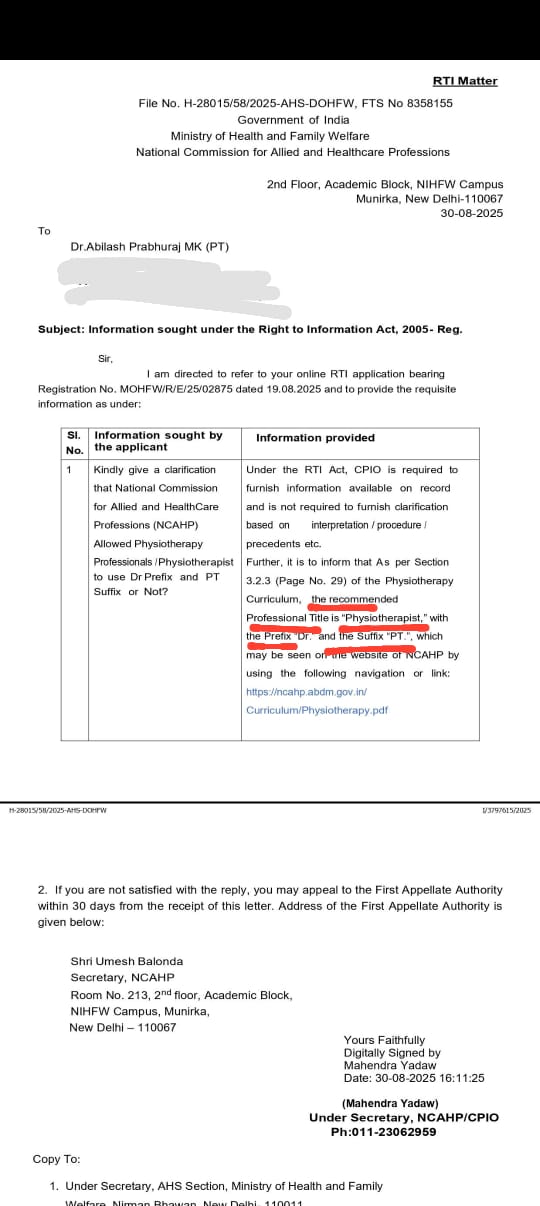
- The Competency-Based Curriculum for Physiotherapy 2025, published by the National Commission for Allied and Healthcare Professions (NCAHP) under the Ministry of Health & Family Welfare in April 2025, included a provision that allowed physiotherapists to use “Dr.” as a prefix and “PT” as a suffix. (01)
- This triggered objections from medical bodies, especially the Indian Medical Association (IMA), which argued that this could mislead patients into thinking physiotherapists are medical doctors. (02)
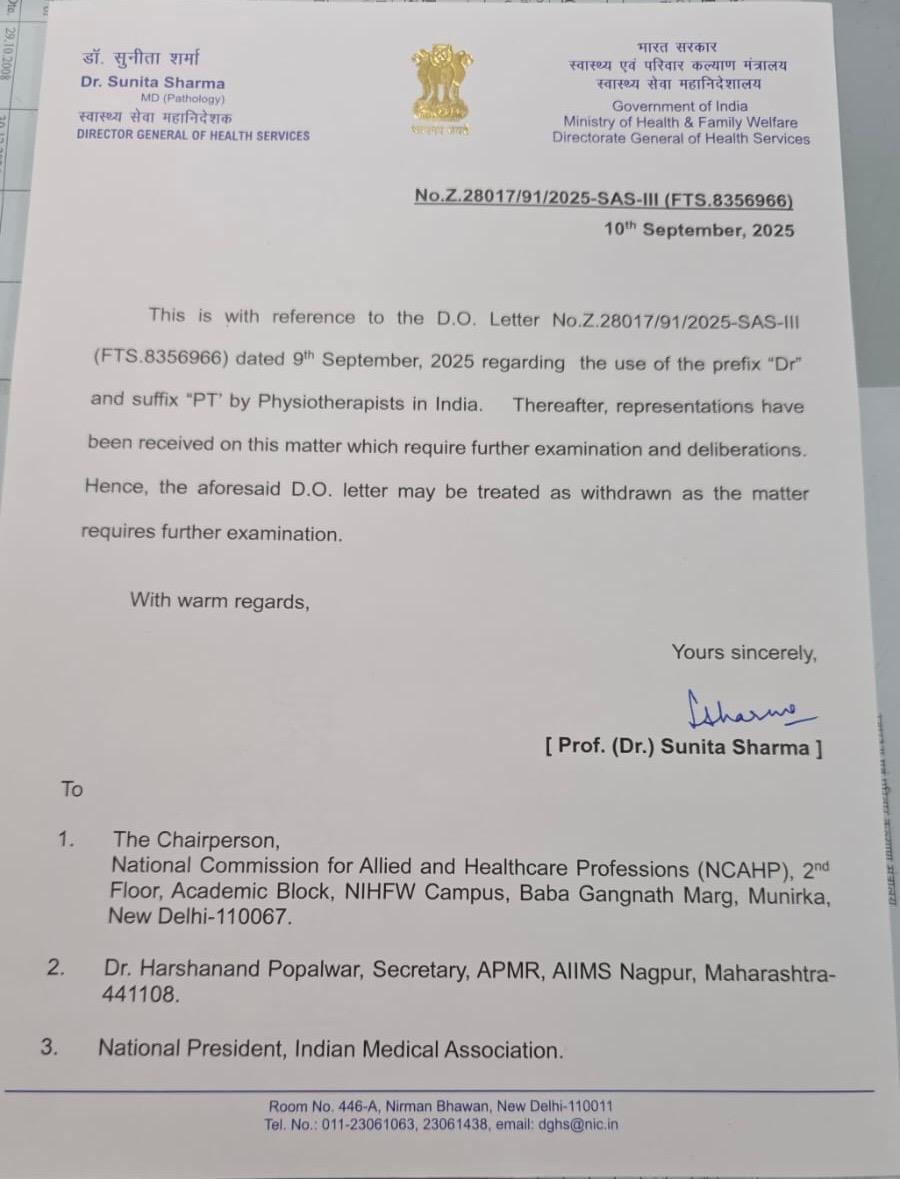
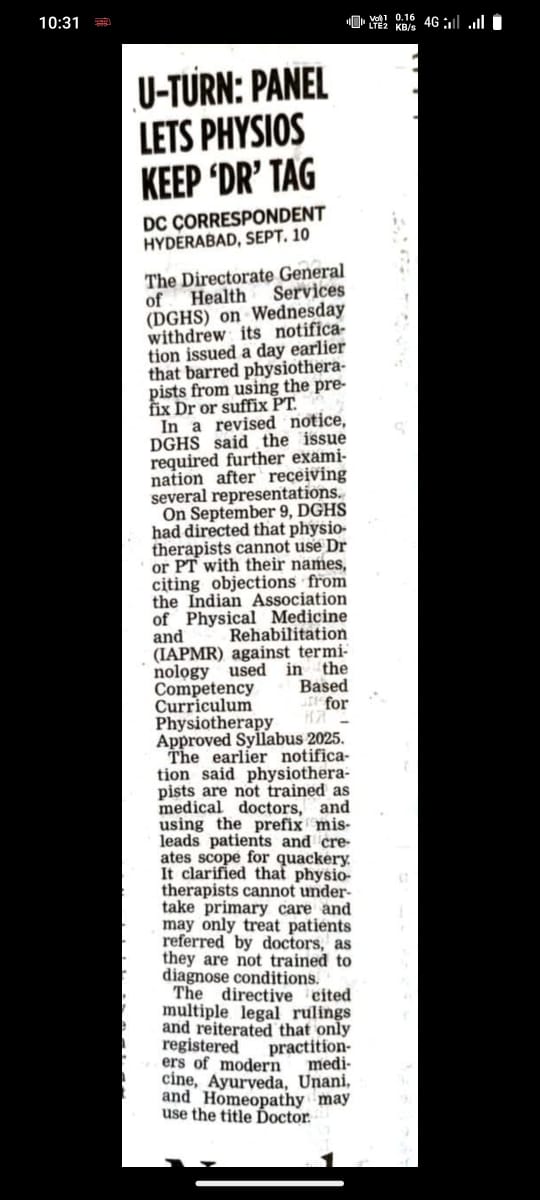
- On September 9, 2025, the Directorate General of Health Services (DGHS) issued a letter to the IMA saying that physiotherapists cannot use the prefix “Dr.”, citing that they are not medical doctors and that their use could violate the Indian Medical Degrees Act, 1916. The DGHS also asked to remove that provision from the new curriculum. (03)
Legal & Regulatory Notes
- DGHS Directive
The DGHS, under Dr. Sunita Sharma, in its letter (dated September 9, 2025), has explicitly stated that physiotherapists are not permitted to use “Dr.” prefix as they are not medical doctors. Use of “Dr.” without proper qualification is seen as misleading and possibly fostering quackery. (04) - Indian Medical Degrees Act, 1916
The DGHS’s letter claims that using “Dr.” by someone who is not a “medical doctor” may violate the Indian Medical Degrees Act, 1916. (05) - Court & High Court Rulings
Multiple rulings have been cited:- Patna High Court (2003): held that physiotherapists not enrolled in the State Medical Register cannot use “Dr.” or practise modern medicine. (06)
- Bengaluru Court (2020): prohibited physiotherapists / occupational therapists from using the “Dr.” prefix and emphasised supervision under medical doctors. (07)
- Madras High Court: upholding that physiotherapists are not recognised as “doctors” under the Indian Medical Council (IMC) Act and cannot use “Dr.” prefix. (08)
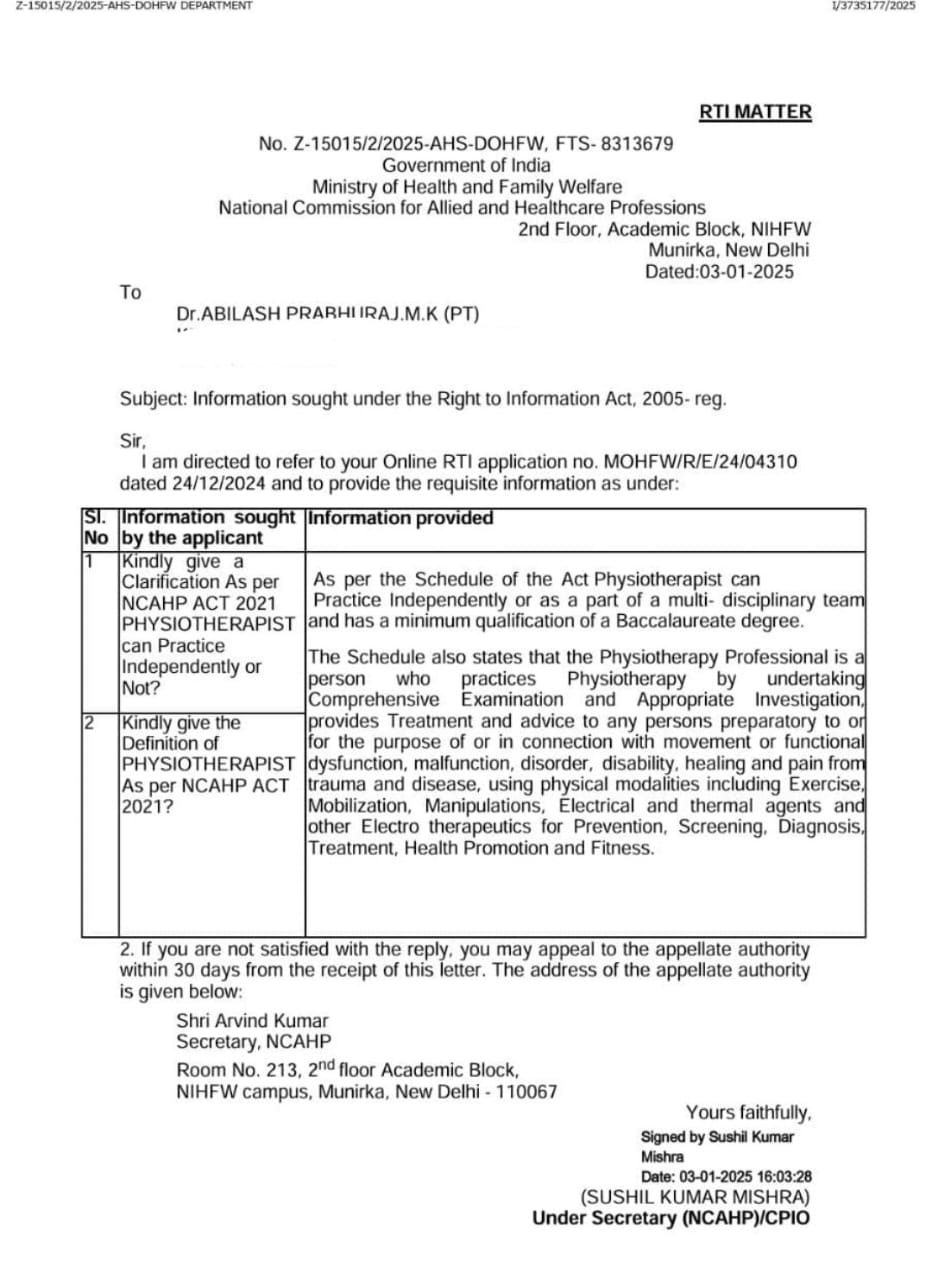
The Flip-Flop: Reversals & Withdrawals
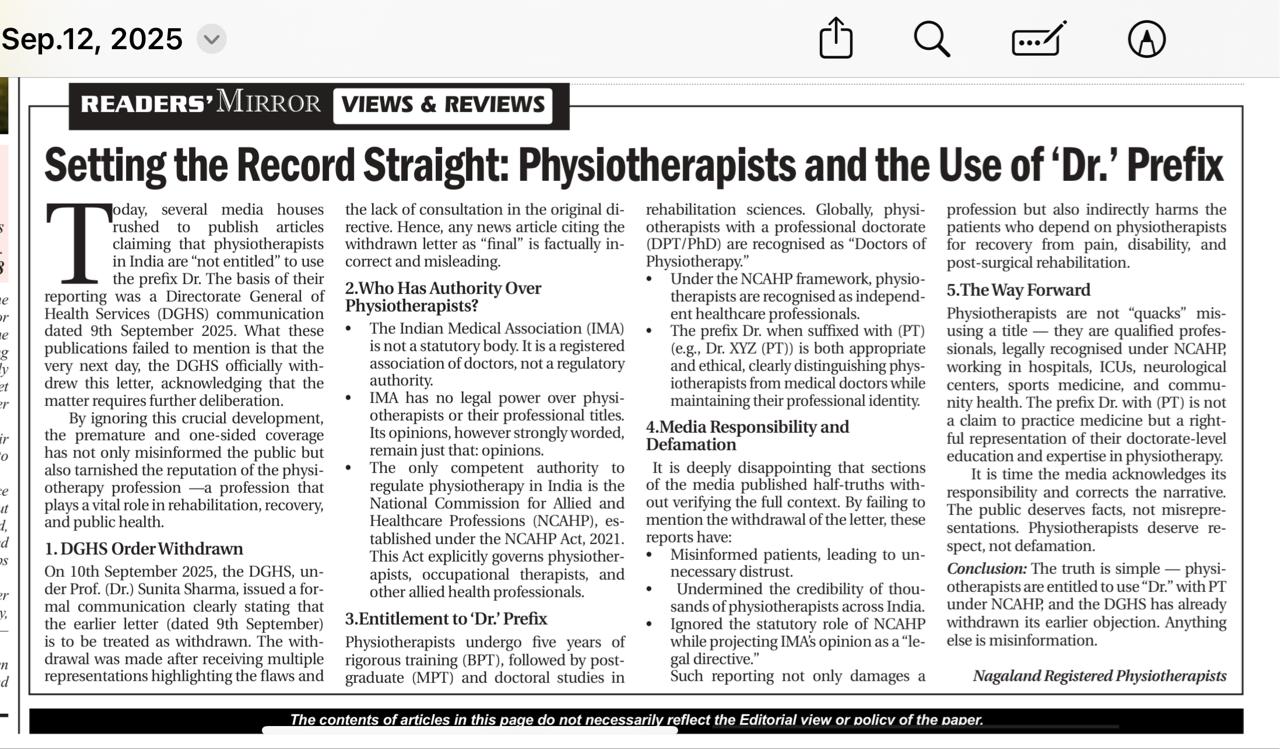
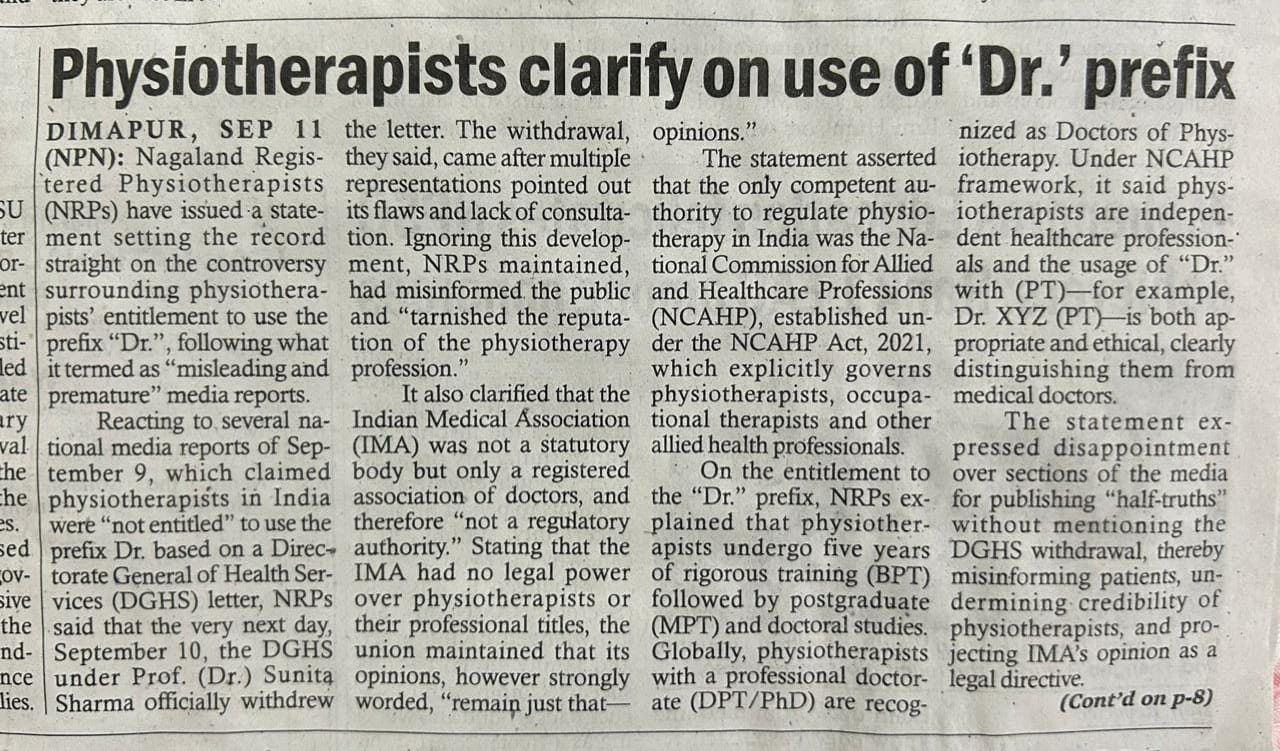
- After DGHS issued the directive forbidding the use of “Dr.”, there was strong pushback from physiotherapy organisations calling for clarity and fairness. (09)
- On September 11, 2025, the DGHS withdrew the September 9 order, saying that the issue needs further examination. For now, physiotherapists are not strictly barred from using “Dr.” prefix, as the matter is under review. (10)
Stakeholders & Their Arguments
Physiotherapists / Allied Healthcare Professionals
- Training & Professional Identity: Many physiotherapists argue that their education (BPT + MPT / equivalent) includes rigorous medical sciences (anatomy, physiology, pathology etc.) enough to merit some recognition. They point out that the suffix “PT” is used to clarify profession, reducing risk of confusion. (11)
- Global Precedents: In several countries, physiotherapists with doctoral credentials (DPT or PhD) use “Dr.” in professional settings, always clarifying that they are not MDs. Physiotherapists in India sometimes point this out. (12)
- Public Trust and Distinction from Quacks: Some physiotherapists claim that using “Dr.” helps them differentiate from unqualified practitioners in the public eye. The problem for them is not using the title per se, but how it’s perceived or misused. (13)
Medical Professionals, DGHS, IMA
- Public Confusion / Risk of Quackery: The main argument is that allowing non-medical doctors to use the “Dr.” prefix could mislead patients, especially those not well-versed in the names of professions / medical qualifications. It might encourage misrepresentation. (14)
- Legal Sanctity & Medical Acts: Medical Acts like the Indian Medical Degrees Act, IMC Act, etc., reserve the title “Doctor” for recognised medical practitioners. Regulatory bodies have also issued advisory opinions over the years that physiotherapists should not be allowed to present themselves as medical doctors. (15)
What the Law / Regulation Actually States
- Indian Medical Degrees Act, 1916: This Act deals with “recognised medical qualifications” and restricts who may practice modern scientific medicine. Using the title “Doctor” in a way that implies practice of medicine without qualifications may violate those legal provisions. (16)
- IMC Act / State Medical Registers: To be a medical practitioner (i.e. someone who may legally practise medicine), one often needs registration in State Medical Registers under the IMC Act or equivalent. Physiotherapists are not enrolled under those registers, so, under several judgments and legal opinions, they are not “medical doctors” in that legal sense. (17)
Practical Implications
- For Patients: The potential for confusion: a patient may assume a “Dr ______ PT” is a medical doctor able to diagnose, prescribe, or treat serious medical conditions, when the physiotherapist’s scope is different. This may lead to misinformed decisions.
- For Physiotherapy Professionals: The ambiguity causes uncertainty about how to present credentials safely, the risk of legal action if found misleading, and impacts on professional reputation. Those with higher qualifications (PhD, DPT) may be more conflicted: do they deserve the title, or will it provoke regulatory issues?
- For Regulation & Curriculum Design: The controversy shows how important clarity in curricula is. Regulatory bodies (DGHS, NCAHP) need explicit rules so that health education does not inadvertently mislead or breach the law.
The DGHS Withdrawal: What It Means
- When DGHS withdrew its September 9 directive (on September 11), it signalled recognition of the concerns raised by physiotherapists and allied bodies. The withdrawal doesn’t mean “yes, you can use it freely” but rather “the matter needs more deliberation.” (18)
- This leaves a transitional period where the curriculum may still have the “Dr.” prefix, but legal/regulatory risk remains until the final decision is taken.
Ethical & Professional Considerations
- Even if physiotherapists are granted the right to use the “Dr.” prefix, best practice would likely require transparency: e.g., “Dr John Doe (Physiotherapist)” or “Dr John Doe, PT” so patients are not misled.
- Distinction of roles: physiotherapy is crucial, especially in rehabilitation, musculoskeletal, neurology, etc., but diagnosing certain conditions or prescribing drugs remains outside the typical scope unless properly qualified and with regulatory backing.
- Patient safety: incorrect self-representation could lead to patients expecting certain medical care that physiotherapists are not legally or practically trained to deliver.
Current Court Rulings Affecting “Dr.” Prefix
📌 Kerala High Court (latest in Nov 2025):
- The Kerala HC interim order has directed authorities to ensure physiotherapists and occupational therapists do not use “Dr.” unless they hold a recognised medical degree.
- This came on a petition from the Indian Association of Physical Medicine and Rehabilitation arguing physiotherapists shouldn’t present themselves as primary healthcare providers.
- The court said using “Dr.” without a medical degree could conflict with the Indian Medical Degrees Act, 1916.
- The matter is listed for further hearing (e.g., Dec 1, 2025). The Times of India+1
🔹 Point to note: These are High Court orders, not Supreme Court final judgements.
📍 DGHS & Government Position (2025)
- The Directorate General of Health Services (DGHS) had issued a directive saying physiotherapists cannot use the “Dr.” prefix because they are not medical doctors, and doing so can mislead the public.
- This was based on legal concerns including the Indian Medical Degrees Act.
- However, the DGHS withdrew that order a day later for further review, saying the matter needed closer examination. Medical Dialogues
🔎 Summary of the Legal Landscape Right Now
📍 Supreme Court:
✔️ A notice has been issued on a plea about enforcing the Allied Healthcare Professions Act — but no ruling that definitively states physiotherapists are “doctors” or permits the “Dr.” prefix. Sci API
📍 High Courts (like Kerala HC):
✔️ Interim directions restrict the use of “Dr.” by physiotherapists without a recognised medical degree. The Times of India
📍 Regulatory (DGHS):
✔️ Government pushed to remove “Dr.” prefix in curricula, citing legal concerns — but has paused enforcement while the issue is reviewed. Medical Dialogues
📌 Current Legal Position on “Dr.” Prefix
✔️ The National Commission governs physiotherapists for Allied & Healthcare Professions Act, 2021 — but this does not automatically make them medical doctors in the legal sense under the Indian Medical Degrees Act, 1916.
✔️ Courts have been cautious or restrictive about allowing the use of “Dr.” unless one holds a recognised medical qualification (like MBBS). The Times of India
What’s Next? Proposed Solutions
- Clear regulatory guideline: The Health Ministry, DGHS, and NCAHP should issue explicit rules clarifying who can use the “Dr.” title and under what conditions (e.g., only with suffix “PT” / only with certain advanced qualifications, etc.).
- Legislative clarity: Possibly amend or clarify via parliamentary legislation or regulatory acts (e.g. Indian Medical Degrees Act, NCAHP Act) to define permissible prefixes for allied health professionals to avoid ambiguity.
- Public awareness campaigns: To educate patients about what a physiotherapist is, the difference from a medical doctor, what treatments they can provide, etc.
- Uniform syllabus adjustments: The curriculum (as in Physiotherapy Curriculum 2025) should be consistent with final regulatory decisions, with prefix/suffix wording clarified, so academic institutions do not unwittingly violate legal directives.
- Ethics code / professional body resolution: Physiotherapy associations might set internal codes of practice about the use of titles, enforce suffix usage, disclaimers, etc.
International Comparison
- In many countries (USA, Canada, Australia), physiotherapists can earn a “Doctor of Physical Therapy (DPT)” or Ph.D., and in those cases may be called “Dr.” but often clarified as “Doctor of Physical Therapy” or with a suffix or in contexts where it’s clear they are not medical doctors.
- Indian physiotherapy associations point to such precedents when arguing for recognition. However, legal systems differ, and permissibility elsewhere doesn’t automatically make it permitted in India.
Conclusion
The debate over whether physiotherapists in India can use the “Dr.” prefix is more than a matter of semantics. It touches on legal regulation, patient safety, professional identity, public trust, and how health professions are recognised. As of September 2025, the regulatory body (DGHS) has moved to forbid the “Dr.” prefix for physiotherapists, citing legal violations and risk of confusion, but then quickly withdrew that directive, placing the issue back into limbo.
Going forward, clarity is essential. Whether physiotherapists will be able to use the “Dr.” prefix permanently depends on legal rulings, regulatory guidelines, and how responsibly the profession frames its identity. What matters most is that patients are not misled, and professionals are respected for their training and contribution without overstepping legal boundaries.
In summary, if you’re searching for “physiotherapist Dr prefix India” or “can physiotherapists use Dr in India”, the current status (as of September 2025) is uncertain. The NCAHP curriculum initially permitted the prefix, the DGHS ordered its removal, citing the Indian Medical Degrees Act, 1916 and several High Court judgments, and then, in a quick reversal, the DGHS withdrew its order pending further review.